
Is SEO Dead? The Truth About Google AI Overviews (2026)
- January 8, 2026
- Deasy Solution
- 148
- 10 Min
In this Articles
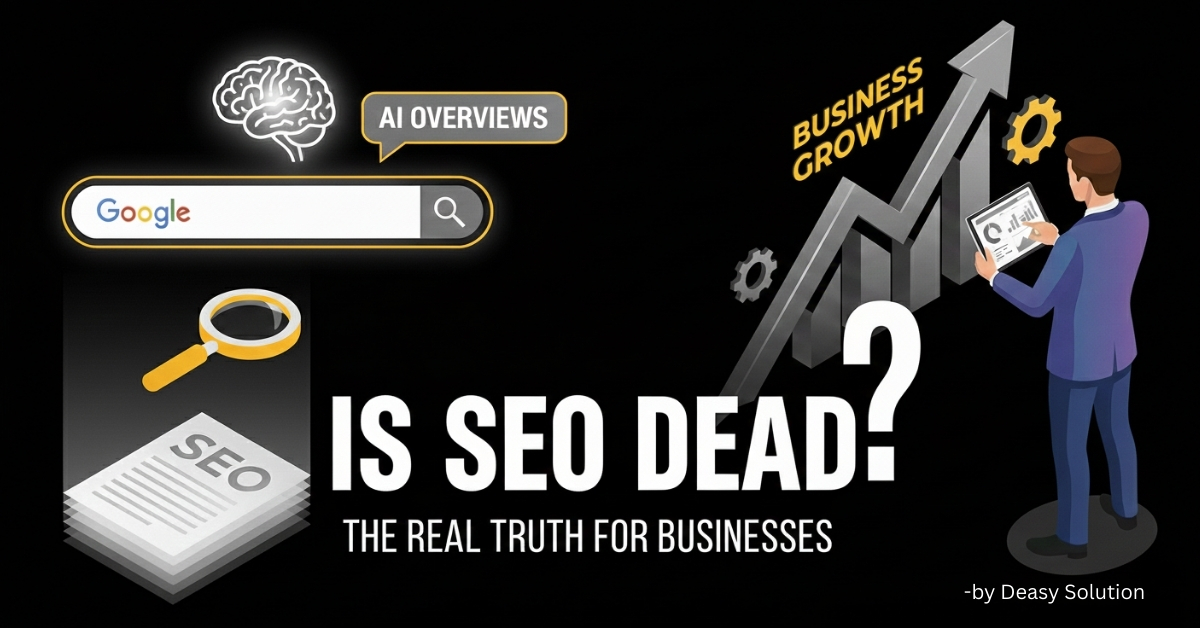
If you have used Google recently, you’ve probably noticed something different. Instead of the usual list of links, you’re often met with a shaded box at the top of the screen—a conversational summary that answers your question instantly.
This is Google AI Overviews (formerly known as SGE).
For business owners, this change has sparked a wave of panic. You might be wondering: “If Google is giving away the answer for free, why would anyone ever click on my website again? Is SEO finally dead?”
As a veteran in the digital marketing space for nearly a decade, I’ve seen many “SEO is dead” headlines. But this time, the shift is real. However, here is the truth: SEO isn’t dying; it’s just getting a massive promotion.
In this guide, we’ll break down what is actually happening and how your business can stay ahead.
What Exactly are Google AI Overviews?
Think of AI Overviews as a super-powered personal assistant. When a user types a complex question, Google’s AI (Gemini) scans the top-ranking websites, pulls out the most relevant facts, and summarizes them into a neat, easy-to-read paragraph.
While this is great for the user, it creates a challenge for businesses. This shift has led to the rise of “Zero-Click Searches”—where people get the info they need without ever leaving the Google results page.
Is this bad news for your traffic?
For simple, “fact-based” queries (like “What time is it in Dubai?” or “How to boil an egg”), yes—traffic will likely drop. However, for businesses offering services, products, or specialized expertise, the story is quite different.
Why SEO is More Alive Than Ever
Despite the drop in “quick” clicks, SEO remains the most powerful way to grow a business online in 2026. Here’s why:
AI Needs Sources: AI doesn’t just make things up (at least, it shouldn’t). It pulls information from high-quality, authoritative websites. If your content is the source for that AI summary, your brand builds massive trust.
The “Quality” of Clicks is Rising: If someone reads an AI summary and still clicks through to your site, they are a much “warmer” lead. They already trust your expertise and are seeking more detailed information.
Complex Decisions Still Need Humans: AI is great at summaries, but it can’t replace human experience, nuanced opinions, or professional services. People still want to read a blog written by a real expert before they make a big purchase.
How to Adapt: 5 Actionable Strategies for 2026
At Deasy Solution – Digital Marketing Company, we’ve spent the last year transitioning our clients from traditional SEO to what we call “Authority-First SEO.” Here is how you can do the same:
1. Focus on Deep “E-E-A-T.”
Google prioritizes content that shows Experience, Expertise, Authoritativeness, and Trustworthiness.
The Fix: Don’t just write “What is [Topic].” Write about “My 10 years of experience doing [Topic].” Share case studies, real-world examples, and unique data that an AI cannot generate.
2. Optimize for “Answer Engine” Queries
AI loves lists, tables, and direct answers.
The Fix: Start your blog posts with a clear, 2-3 sentence summary of the main answer. Use bullet points and H3 subheadings that are phrased as questions. This makes it easier for Google’s AI to “cite” you as the source.
3. Move Toward “Long-Tail” Keywords
Broad keywords like “Digital Marketing” are now dominated by AI Overviews.
The Fix: Target more specific, “conversational” phrases. Instead of “SEO tips,” target “How to adjust my SEO strategy for AI Overviews in 2026.” These specific searches are less likely to be satisfied by a generic AI summary.
4. Use Structured Data (Schema Markup)
This is the technical side of SEO. A schema is like giving Google a map of your content.
The Fix: Ensure your website uses FAQ schema, Article schema, and Product schema. This helps the AI understand exactly what your page is about so it can recommend you.
5. Build a Brand, Not Just a Website
In an AI world, people search for brands they trust.
The Fix: Don’t just rely on Google. Build your presence on LinkedIn, YouTube, and through email newsletters. When people search for your brand name specifically, you win every time.
Real-World Example: A Local Law Firm
A law firm used to rank #1 for “What is a personal injury claim?” After the AI Overviews, their traffic for that term dropped.
However, they shifted their strategy to: “How our firm handled a $1M motorcycle accident case in Florida.” Because the AI couldn’t replicate that personal story, the law firm saw an increase in actual leads—people who were ready to hire them, even if the total number of website visitors was lower.
The Verdict: Don’t Panic, Evolve
The “death” of SEO is a myth. What we are seeing is the death of lazy SEO. You can no longer just “stuff” keywords into a page and expect to rank.
In 2026, the businesses that win are the ones that provide the most value, the clearest answers, and the strongest proof of expertise. If you focus on being the best resource for your customers, Google’s AI will naturally want to show you off.
🙋♂️ FAQs: SEO after Google AI Overviews
No. AI summarizes information, but it cannot replace the depth, personality, and updated accuracy of a well-maintained blog.
You can check this in Google Search Console. Look for “Search Appearance” and see if your links are appearing in “Generative” results.
AI tools are great for outlining and research, but “Pure AI” content is being devalued by Google. Always ensure a human expert (like the team at Deasy Solution) edits and adds personal insight to every piece.


Digital Marketing Digital Marketing career 360 Digital Marketing Agency 10 Min In this Articles Digital
Digital Marketing Digital Marketing career 360 Digital Marketing Agency 10 Min In this Articles Fashion
